The ocean as a reservoir for human carbon dioxide
environmentmarine conservationoceanclimate changecarbon sink

The ocean absorbs 90 percent of the additional heat energy from the atmosphere
(c) Jan Steffen / GEOMAR (CC BY 4.0)
Research project determines the CO₂ uptake of the oceans between 1994 and 2007 Not all carbon dioxide (CO₂) released into the air when burning fossil fuels remains in the atmosphere and contributes to global warming. The oceans and ecosystems in the countryside absorb significant quantities of man-made CO₂ emissions from the atmosphere. Without this so-called carbon sink, the CO₂ concentration in the atmosphere would be significantly higher and the human-induced climate change correspondingly stronger. Oceans absorb CO₂ in two steps: First, the CO₂ dissolves in the surface water. Then it is distributed by marine circulation pumps. Ocean currents and mixing processes transport the dissolved CO₂ from the surface deep into the ocean basins, where it accumulates over time. The question of how much of human CO₂ the ocean takes up exactly is central to climate research. An international team of scientists led by the ETH Zurich and with the participation of the Alfred Wegener Institute has now succeeded in precisely determining the CO₂ uptake potential of the ocean over a period of thirteen years. As reported by the researchers in the current issue of Science, between 1994 and 2007, the world's oceans raised a total of about 34 gigatons (metric tons) of man-made carbon from the atmosphere. This corresponds to around 31 percent of the total man-made CO₂ emissions during this period. The percentage of CO₂ intake does not differ from the previous 200 years since industrialization, but the absolute amount: as long as the atmospheric concentration of CO₂ increases, the CO₂ uptake potential of the oceans develops approximately proportionally - the higher the CO₂ content in the air, the more it is absorbed by the sea - until it is saturated at some point. While the overall results indicate a persistently high storage function of the oceans in the global carbon budget, the researchers found significant differences in the storage rates of different marine regions. Thus, between 1994 and 2007, the North Atlantic Ocean absorbed about 20 percent less CO₂ than it should. "This is probably due to the weakening North Atlantic circulation pump of the late 1990s, which in turn was caused by climate variability," explains Nicolas Gruber, Professor of Environmental Physics at ETH Zurich. The lower the CO₂ uptake capacity in the North Atlantic, meanwhile, was accompanied by significantly higher uptake in the South Atlantic, with the result that the overall Atlantic increase in man-made CO₂ as a whole developed as expected. The researchers also documented similar fluctuations in the Southern Ocean, the Pacific and the Indian Ocean. Prerequisites for this research were elaborate measurements of the CO₂ concentration and other chemical and physical parameters in the different seas from the surface to the seabed up to six kilometres deep. More Information: www.ethz.ch Link to the study: science.sciencemag.org/content/363/6432/1193
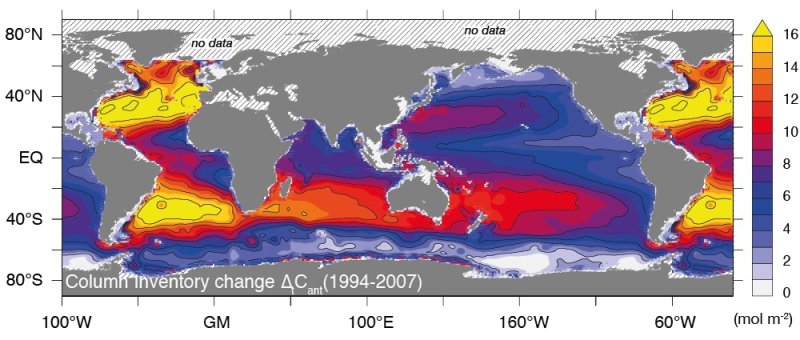
Increase of manmade CO₂ (column up to 3000 meters depth) in the oceans between 1994 and 2007. Areas with a high increase are coloured yellow,
(c) Gruber et al., Science, 2019

Our seas are gigantic heat storage
(c) Olaf Klodt
מאמר זה תורגם אוטומטית וייתכן שהוא מכיל אי דיוקים קלים; אנא עיינו בגרסה המקורית באנגלית במקרה של ספק.