Lead from fuels still present in European shelf seas
environmentmarine lifemarine conservationoceanpollution
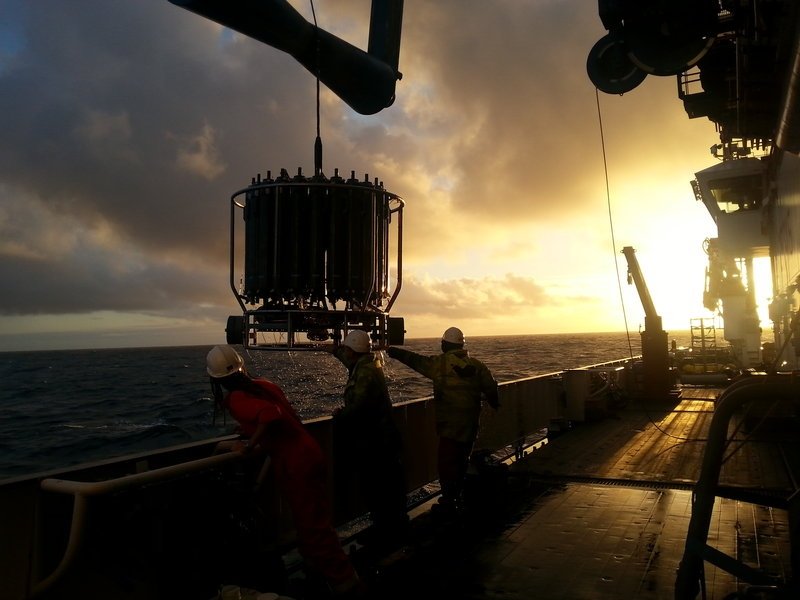
Water sampling in the Celtic Sea with a clean CTD System. photo. © D. Rusiecka, GEOMAR
Element measured in marine environment years after phasing out of leaded fuel For many decades, lead (Pb) has been released into the atmosphere as a result of human activity, such as the burning of leaded fuel. A research group headed by the GEOMAR Helmholtz Center for Ocean Research Kiel has now shown that, following the end of the use of leaded fuel in Europe, lead concentrations in European icebergs have fallen by one quarter. However, the study, recently published in the journal Geophysical Research Letters, also shows that the legacy of historical global lead pollution is still present Lead (PB) is one of the few elements where the impact of human activities on the marine environment is clearly evident. It has no biological function and is toxic to humans and marine organisms. The anthropogenic perturbation dates back to the middle of the 19th century, with coal and leaded gasoline combustion serving as major Pb sources to the atmosphere. Anthropogenic Pb is transported in the atmosphere over long distances and deposited in remote areas resulting in enhanced Pb concentrations in surface oceans of >190 pmol kg-1 during the peak of the Pb emissions in 1970-80. These are about 100 times higher than natural background levels. Since then, lead emissions have fallen due to stricter environmental regulations. Leaded gasoline is now phased out, which also led to a decrease in lead concentrations in the upper layers of the water column. This is also shown by new observational data from European shelf seas, which were collected in the new study. Nevertheless, the legacy of lead pollution, especially from the Mediterranean, is still present and new lead sources are emerging in the marine environment. Recent studies on lead concentrations in European shelf seas have been conducted when leaded gasoline was still widely used. In the new study, the marine biogeochemist Dagmara Rusciecka, dr. Martha Gledhill and Professor Eric Achterberg from GEOMAR found that four times lower lead concentration was measured in surface water off Ireland compared to measurements two to three decades ago. "This is the first study to show a significant reduction in lead levels in European surface waters since the end of leaded gasoline use," said Dagmara Rusiecka, PhD student and lead author of the study. "It underlines that the end of the use of leaded gas has led to a significant reduction in atmospheric Pb pollution and sedimentation in waters," Rusiecka continued. However, the lead concentrations in the study area are still 10 to 60 times higher than the natural background values. The lead taken up by the ocean is ultimately deposited in the sediments. "As the atmospheric inputs have decreased, we can now see that more lead is being released from the sediments, creating a new source of Pb for the environment," explains Prof. Dr. med. Eric Achterberg. Interestingly, water masses from the Mediterranean, which reach the Western European marginal seas at a depth of about 1000 meters, still carry a strong anthropogenic Pb signal. A lot of lead from neighbouring countries has been registered in the Mediterranean Sea, especially since leaded gasoline was used until 2003 in Italy, Spain and Greece. The results are based on expeditions carried out in the European shelf seas between Ireland and France (Celtic Sea) in 2014-2015. Dagmara Rusiecka collected water samples for Pb measurements at numerous sites in the Irish Sea, which were then analyzed in special laboratories at the GEOMAR. In summary, Professor Eric Achterberg says: "We now see reductions in lead concentrations in the surface layers of the European shelf seas due to the decline in Pb emissions. Surprisingly, the sediments that have accumulated lead over the past 150 years have now become a source of lead for the overlying water column. We had assumed that lead binds very strongly to particles and thus is permanently trapped in the sediment. Therefore, we now assume that it will take much longer for the lead concentrations in the marginal seas to return to their natural background levels. "
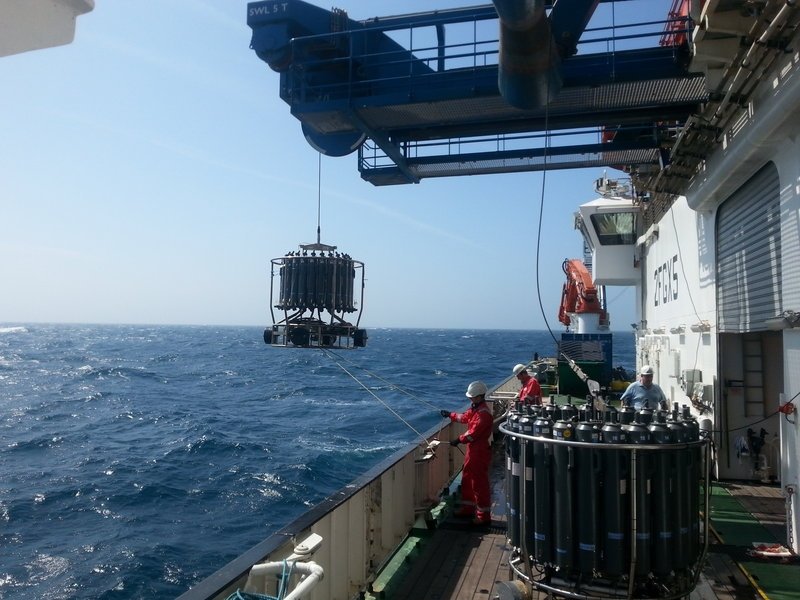
Water sampling in the Celtic Sea with a clean CTD System. photo. © D. Rusiecka, GEOMAR