Effects of methane seepage less than ocean absorption of carbon dioxide
environmentmarine lifearcticmethanegreenhouse gas
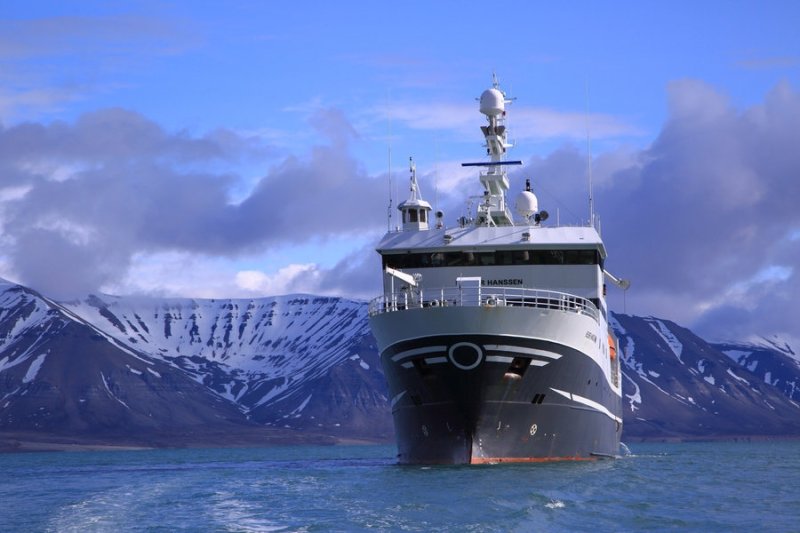
The research vessel HELMER HANSSEN, off the coast of Spitsbergen. © Randall Hyman
International researchers investigate gas emissions in Arctic Large quantities of the greenhouse gas methane are trapped in the
Arctic seabed. If it is released and reaches the atmosphere, it will
worsen global warming. However, an international research team has
discovered that methane sources in the seabed in front of Spitsbergen
do not necessarily have this effect; in fact, it can even help to
remove the greenhouse gases from the atmosphere.
As a gas, methane is one of the most efficient and the most
climate-friendly of the fossil fuels. As a free gas in the atmosphere,
however, it is a potent greenhouse gas, one which exceeds that of
carbon dioxide by a factor of 30 over a period of 100 years. Therefore,
many scientists are concerned about the Arctic permafrost and seabed,
which hold huge amounts of methane within. Would they be released as
the temperatures rise and subsequently accelerate climate change?
A team of US, Norwegian and German researchers has studied the gas
exchange between the Arctic seawater and the atmosphere directly above
the natural methane sources on the seabed. Their surprising conclusion
was that the ocean waters absorbed 2,000 times more carbon dioxide from
the atmosphere than the amount of methane escaping into the atmosphere
from the same waters.
Even if one takes into account the more powerful greenhouse effect of
the methane, there is a smaller effect on the greenhouse effect in
these areas, " said co-author GEOMAR’s Prof Dr Jens Greinert in German.
The study was recently published in the international trade journal
Proceedings of the National Academy of Sciences of the United States of
America (PNAS).
The investigations on which the study was based were carried out near
the Norwegian island of Spitsbergen. On board the Norwegian research
vessel HELMER HANSSEN, the team continuously measured the
concentrations of methane and carbon dioxide in the ocean near the
surface and in the air directly above the ocean surface. Within the
study zone, there were sites with water depths of 80 to 2,600 metres
where methane bubbled out from the seabed and entered the seawater.
An analysis of the data confirmed that the methane being released was
entering the atmosphere at water depths of 80 to 90 metres. However, it
also showed that the topmost water layers were absorbing large amounts
of carbon dioxide at the same time. "The CO2 absorption at the methane
sources was significantly greater here than in neighbouring areas
without the methane seepage from the seabed," said Prof Greinert.
The reason for this is the photosynthetic algae. They are much more
active over the methane sources and can absorb more carbon dioxide.
Together with the methane-rich waters, the nutrient-rich water flows
out from the seabed to the surface and promotes the growth of more
algae.
Prof Greinert describes this study as the first to show the connection
so clearly. However, there is no evidence of any connection between the
existence of methane sources and the transport of soil water to the
ocean surface.
"If what we observed near Svalbard
occurs more broadly at similar locations around the world, it could
mean that methane seeps have a net cooling effect on climate, not a
warming effect as we previously thought," said lead author
biogeochemist Prof Dr John Pohlman of the US Geological Survey. This
would be the exact opposite of what the scientists had anticipated.
Further research in other parts of the ocean would be needed to confirm
the hypothesis.
Link to the study
Este artículo se ha traducido automáticamente y puede contener pequeñas inexactitudes; en caso de duda, consulta la versión original en inglés.