LED Lights: Lighting up the deep seas
environmentunderwater technologydeep sea explorationled lighting
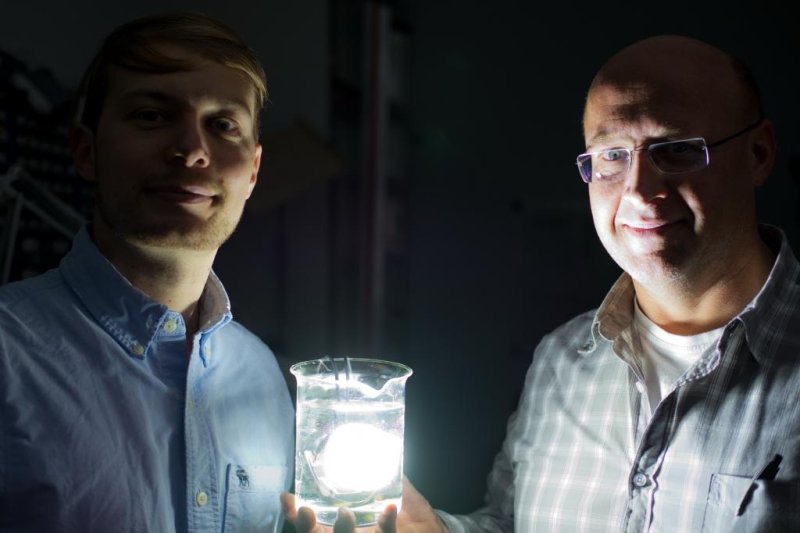
Dr Tom Kwasnitschka (left) and Dipl.-Ing. Jan Sticklus bringing light to the deep sea with their innovation. Photo: © Jan Steffen, GEOMAR
GEOMAR team wins first prize at ideas competition
Two staff members of the GEOMAR Helmholtz Center for Ocean Research
Kiel were awarded the top prize in Schleswig-Holstein’s ideas
competition for Business Development and Technology Transfer
Corporation of Schleswig-Holstein (WTSH) and Kiel University of Applied
Sciences (FH Kiel). They received the prize for their development of pressure-proof LED
lighting, which have already proven their worth in numerous deep-sea
expeditions. Schleswig-Holstein’s Minister of Economic Affairs Reinhard
Meyer officially handed over the prize money of 5,000 Euros during a
ceremony at the FH Kiel on November 7th.
The deep sea covers more than half of Earth's surface. The high
pressures, low temperatures and zero-light conditions make their
exploration quite difficult. In addition, it is here that many natural
catastrophes like earthquakes and tsunamis originate. The deep sea also
serves as an important carbon storage, and therefore has an influence
on the climate. What’s more, the seabed contains various mineral
deposits and is also a possible site where the origins of life can be
found. Hence, All these are reasons to look at them more closely.
To enable the deep seas to be explored easier, engineer Jan Sticklus
and geologist Dr Tom Kwasnitschka from GEOMAR have developed a new
lighting system for underwater devices that is light,
pressure-resistant, corrosion-resistant and cost-effective. At the same
time, it gives off a large amount of light. This innovation has now
been awarded the first prize of the Schleswig-Holstein’s ideas
competition.
As the sponsor of the competition, Mr Meyer congratulated the team.
This idea was originally intended to help answer fundamental questions
about the seas. However, it also has many other applications for the
maritime industry. This shows that top-class basic research and
everyday developments in Schleswig-Holstein can go hand in hand, " he
said in German.
The innovation came about because some working groups at GEOMAR wanted
to film larger areas of the seafloor. However, as Dr Kwasnnschka
explained, the conventional lighting systems for the deep sea were
dependent on large housing due to the pressure and the fact that they
require a lot of energy. If they had used such devices, only a few
square metres of the seafloor would be lit.
Hence, together with Sticklus, he evaluated how to use powerful and
energy-efficient LED light sources on underwater robots and autonomous
vehicles. Starting with liquid-filled variants (which was later
rejected), they came to the issue of the cast construction. The LEDs,
together with the reflector, are embedded in a transparent synthetic
resin using a special patented process.
The plastic encapsulation, which is free of bubbles and has thin walls,
enables the LEDs to be utilised at virtually all depths. The salt water
will not reach the electronics and an adequate dissipation of heat is
ensured.
Using 24 of these LEDs, the two scientists built an extremely light
system for GEOMAR’s AUV ABYSS (Autonomous Underwater Vehicle). Thanks
to the new lighting technology, the ABYSS was able to produce hundreds
of thousands of photos of the manganese nodules in the seabed of the
central Pacific Ocean in summer 2015 ( as we reported here From this, the researchers created a high-resolution photomosaic
that mapped several square kilometres of the seabed. They can use the
photomosaic to examine the distribution of the nodules as well as the
organisms living there, " said Dr Kwasnitschka. By doing this, the
researchers can obtain more details about the ecological consequences
of the degradation of manganese nodules in the deep sea.
In addition, the subject of underwater lighting also has an economic
importance. This ranges from aquariums to port and offshore facilities.
We are just about to expand the system to more applications, " said
Sticklus. " Receiving the award is, of course, a great motivator. That’s
why we are very happy about it. "
See here for more information
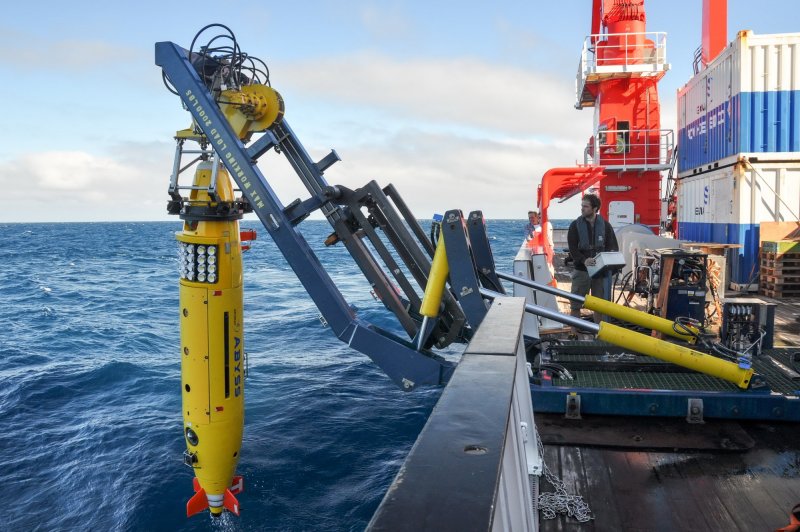
The GEOMAR’s AUV ABYSS is equipped with 24 of the new LED lights. Photo: © Emanuel Wenzlaff, GEOMAR
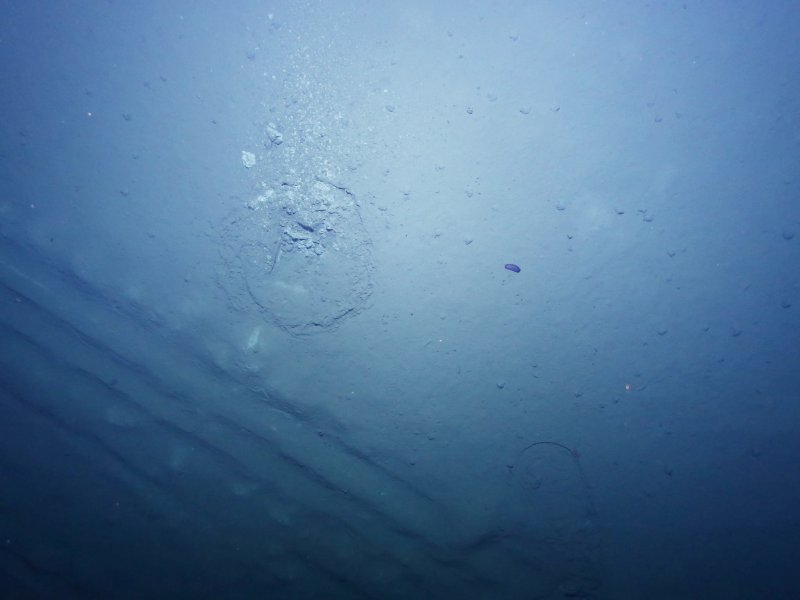
A shot of the seabed in the East Pacific at a depth of 4,000 metres. Thanks to the new LED technology, the scientists at GEOMAR were able to create hundreds of thousands of such images to form a huge photomosaic. Photo: © AUV "ABYSS", GEOMAR
이 기사는 자동 번역되었으며 약간의 오류가 포함될 수 있습니다. 의심스러운 점이 있으면 원문 영어 버전을 참조하십시오.