Deep-sea mining: Research on risks and ecological consequences
environmentmarine conservationdeep-sea miningecological consequencesinternational law
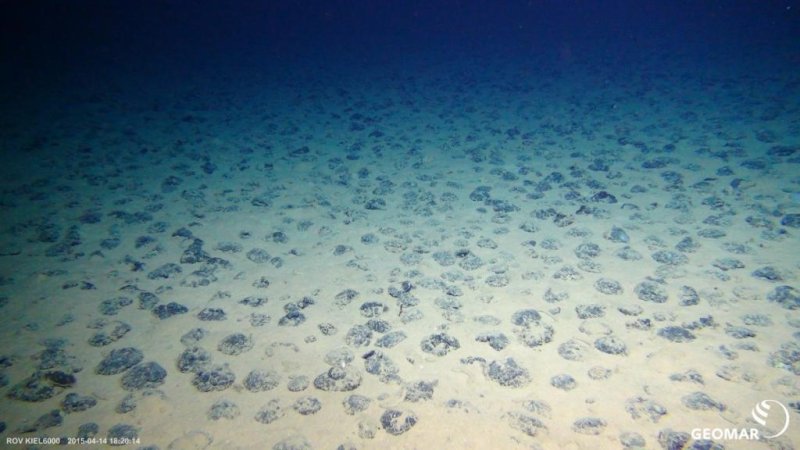
Manganese nodules in the Clarion Clipperton Zone in more than 4000 meters of water. In a few years, the first states could apply for mining licenses for manganese nodules at the International Seabed Authority (ISA), photo: © ROV-Team / GEOMAR (CC BY 4.0)
"Mining Impact: Phase 2 of the project started in Brussels
There are still no mining licenses for the deep-sea outside national economic zones. That could change in a few years. Coordinated at the GEOMAR Helmholtz Center for Ocean Research Kiel, the international project "MiningImpact" has been investigating the ecological consequences of deep-sea mining since 2014. Now, the second phase of the project has started in Brussels. 32 facilities from 10 countries are involved in the project. Mineral resources in the deep sea outside the Exclusive Economic Zones (200 nautical miles) off the border are managed by the International Seabed Authority (ISA). They belong to the "heritage of humanity" based on the International Convention on the Law of the Sea (UNCLOS). To date, 20 states, including the European countries Belgium, Germany, France, Great Britain, Poland and Russia, have acquired licenses to explore ore deposits in the seabed. In the Clarion-Clipperton Zone (CCZ) in the north-east Pacific Ocean between Mexico and Hawaii, the largest of the deposits is manganese nodules. At the beginning of the next decade, some of the exploration contracts will be in CCZ. Then, after exploration of these ore deposits mining could start pretty soon. Regarding this background, scientists in the "Mining Impact" project are investigating the ecological consequences of future deep-sea mining. The findings feed into the negotiations for the ISA's "Mining Code", which will be the international set of rules for the extraction of mineral resources on the sea floor. Now the second phase of the project "Mining Impact" starts in Brussels. The project was presented to international environmental associations, representatives of deep-sea mining companies, ministries and the European Parliament in a public discussion event. As part of the JPI Oceans Healthy and Productive Seas and Oceans program, the participating countries are funding the new phase with a total of 11 million Euros. The participating research institutions will contribute another 6 million Euros to the project. In the first phase, we gained a lot of basic insight into the expected longer-term effects of deep-sea mining. We want to concretise this now, in which we identify appropriate indicator organisms for a healthy state of the deep-sea ecosystem and define limits for deep-sea mining damage that the ecosystem can still cope with. Because the ISA must be supported by the international scientific community in the creation of the Mining Code so that it sets the best possible environmental standards, " explains project coordinator Dr. Ing. Matthias Haeckel from GEOMAR. A key component of the second phase of the MiningImpact project will be to assess the technology test of the Belgian contractor DEME-GSR in the CCZ through an independent scientific investigation. In the spring of 2019, the company plans to use a collector prototype on the seabed to harvest manganese nodules on a 0.1 square kilometre area. " At the same time we will be on site with the German research vessel 'SONNE' to gather independent scientific data on the environmental impact of this first industrial test of a tuberous collector. For example, we are interested in how far the sediment that is being stirred up is drifted and how long it stays in the water column until it settles again, " explains Dr. med. Haeckel. At the same time, the researchers are testing how compliance with the future mining code in the deep sea can be monitored. In addition, they are gaining further insights into how deep-sea protection zones must be designed to limit the negative effects of industrial activities on the seabed. "International maritime law are an opportunity for nations to extract mineral resources from the deep sea. That's out of the question. But now we still have the opportunity to shape the framework so that there is no uncontrolled exploitation in the largest habitat on earth. We want to use this opportunity," emphasizes Dr. med. Haeckel.
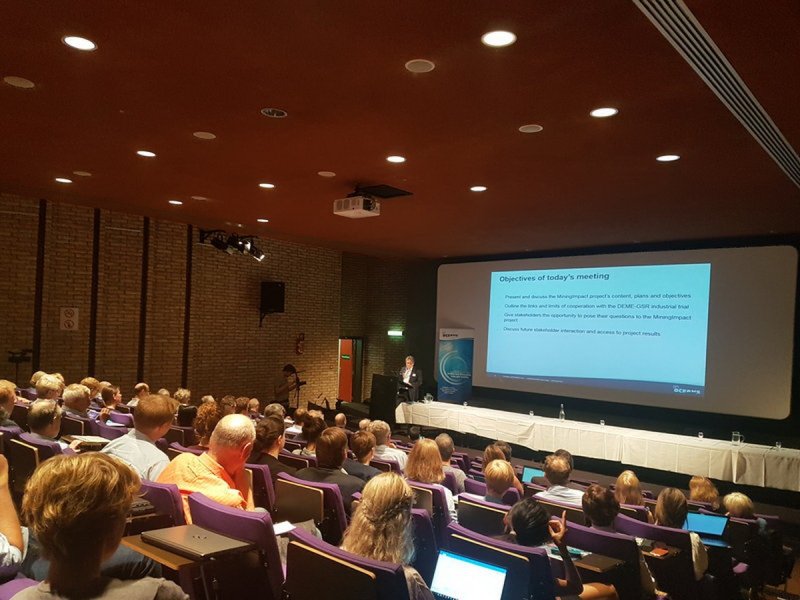
The MiningImpact project was presented to international environmental organizations, representatives of deep-sea mining companies, ministries and the European Parliament, photo: © Kristin Hamann / GEOMAR
Logo "Mining Impact"
이 기사는 자동 번역되었으며 약간의 오류가 포함될 수 있습니다. 의심스러운 점이 있으면 원문 영어 버전을 참조하십시오.