Researchers discover Arctic climatic conditions during the late Miocene era
environmentarcticmarine researchsea iceclimate historymiocene era
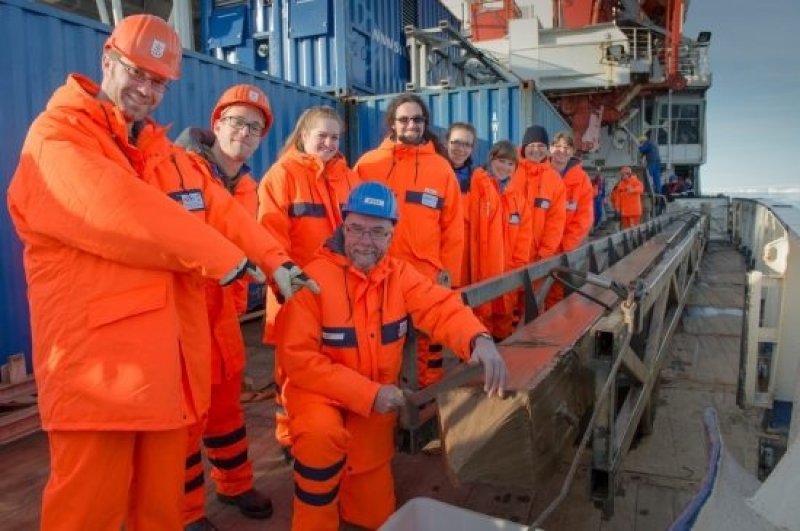
Joy at a successful extraction of a sediment core bore: Polarstern expedition leader Prof Dr Rüdiger Stein (in blue helmet) and his team posing beside the gravity corer containing the sediment core. (Photo: Alfred Wegener Institute / Audun Tholfsen, UoB)
An international team of scientists led by the Alfred Wegener Institute (AWI) Helmholtz Centre for Polar and Marine Research has managed to shed some light into the climate history of the Arctic Ocean. Using soil samples from the Lomonosov Ridge, they were able to prove that the central Arctic was completely ice-free during the summer six million to ten million years ago, with the temperature at its surface at 4 to 9 degrees Celsius.
As for spring, autumn and winter, ice floes would have been floating on the surface. The new data signifies a fundamental step for recreating past Arctic climatic conditions and can be used to verify climate models, as reported in the current issue of the journal Nature Communications.
The samples used in the study had been collected in the summer of 2014, during an expedition on board the research vessel Polarstern. Describing the Arctic sea ice as a very important and sensitive factor in the global climate system, AWI geologist, expedition leader and lead author Prof Dr Rüdiger Stein said that it was important to better understand the causes of the present and past changes in the sea ice.
"For this expedition, our goal was to take sediments from the central Arctic, which we can use to reconstruct the sea ice in the past 50 million years. Until now, we have lacked the appropriate soil samples and thus the data to reconstruct the periods of this magnitude," said Prof Dr Stein in German.
The western slope of the Lomonosov Ridge, a big underwater mountain range in the central Arctic, was chosen as the site for the sampling. This was because the site had experienced repeated large landslides in the past, causing the underlying sediments and rock formations to be exposed to a thickness of about 500 metres. The researchers were also surprised at the extent of the submarine separation edges (tectonic edges), which spanned over 300 kilometres from the North Pole almost to the southern end of the ridge on the Siberian side.
Using the sediment core as climate archive
Of the sediment cores extracted over two days (all about four to eight feet long each), one of them turned out to be ideal to be used as a climate archive. Using microfossils called dinoflagellates, the researchers were able to determine that the sediments in the lower portion of the core were about from six million to ten million years ago, dating back to the late Miocene. The samples extracted hence gave the researchers a unique opportunity to reconstruct the climatic conditions in the central Arctic Ocean for which there had been very vague and contradictory data so far.
Some scientists believed that during that time, the central Arctic Ocean was covered by ice all year round – the way it is today. However, this assumption appears to run contrary to the research findings. Based on the new data, during that period in history, in the summer, the North Pole and the central Arctic Ocean must have been ice-free during the summer.
Biomarkers give insight into past climate
This analysis is based on biomarkers, which are organic compounds comprising organisms that had been alive in the past but are now preserved in the sediment. Two of these biomarkers had been extracted from the soil samples. The first group were calcareous algae that existed on the surface of the water, requiring open water and relied on sunlight for producing food/energy. In the central Arctic Ocean, sunlight is only available during the spring and summer months, while it turns dark during the remaining months. Hence, the data derived from the biomarkers of the calcareous algae can indicate the climatic conditions during those summer months.
In addition, the calcareous algae developed different biomarker molecules due to the water temperature. Based on the molecules, Prof Dr Stein said that they calculated the surface temperature of the Arctic Ocean to be about 4 to 9 degrees Celsius, which indicated ice-free conditions during the summer.
The second group of biomarkers, comprising Arctic sea ice diatoms, showed that the Arctic Ocean was not ice-free all year around. Prof Dr Stein said that by comparing their records to the surface water temperatures and sea ice distribution, they could show that the central Arctic Ocean might have been ice-free during the summer six million to ten million years ago. In the spring and previous winter, the sea ice would be present.
He added that the North Pole must have had a similar seasonal ice cover as is currently found at the Arctic marginal seas.
New data can improve climate models
This reconstruction of the Arctic's past climate has been supported by climate simulations. However, this presumes a relatively high atmospheric carbon dioxide content of 450ppm. This is because in some studies concerning the late Miocene, if the carbon dioxide content was lower, at about 280 ppm, an ice-free Arctic could not be reconstructed.
In any case, whether the carbon dioxide content during the Miocene was excessively high or the Miocene simulations possessed insufficient sensitivity in the Arctic has yet to be determined and requires further research.
As Prof Dr Stein said, "if our climate models can reliably reproduce the sea ice cover of earlier periods, we would also be able to provide more accurate predictions of future climate and sea ice fluctuations in the central Arctic."
Link to study.
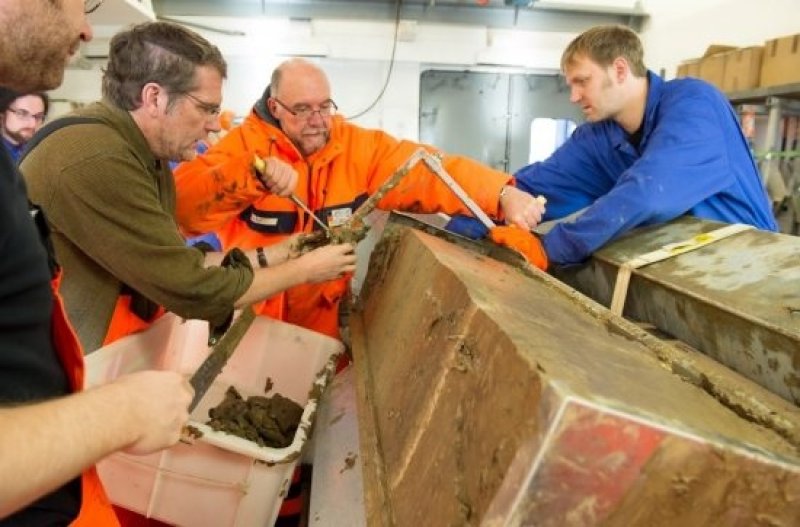
Polarstern expedition leader Prof Dr Rüdiger Stein (center, in orange clothing) and his team examine the salvaged sediment core from the Lomonosov Ridge aboard the Polarstern lab. (Photo: Alfred Wegener Institute / Audun Tholfsen, UoB)
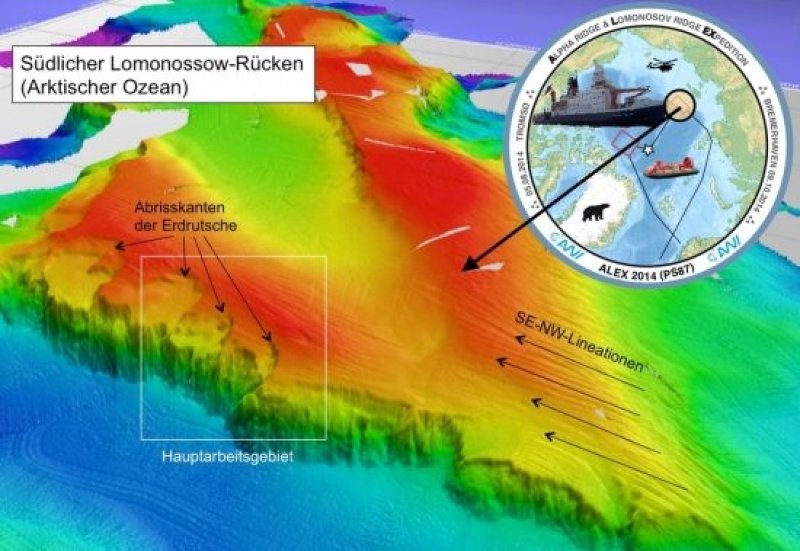
Bathymetric view of the western slope of the Lomonosov Ridge, where the sediment cores were recovered. (Photo: Rüdiger Stein)
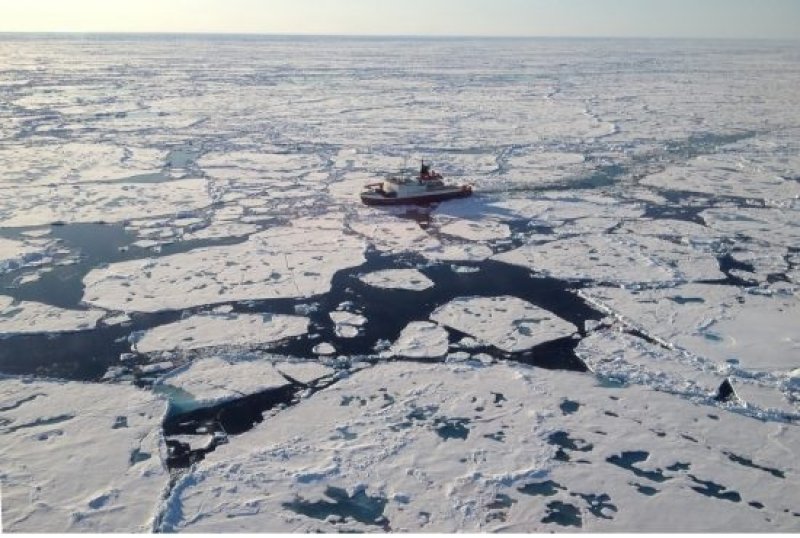
The German research vessel Polarstern on its journey across the Lomonosov Ridge in the central Arctic Ocean. (Photo: Alfred Wegener Inst
Tento článek byl automaticky přeložen a může obsahovat drobné nepřesnosti; v případě pochybností se podívejte na originální anglickou verzi.