Polar ice could be softer than expected
environmentclimate changesea-level risepolar iceice flowgreenland ice sheet

Arctic Glacier
Models for sea-level rise need to be adapted Ice has similar flow characteristics as a very viscous liquid. The ice sheets of the polar ice therefore flows under its own weight towards the ocean. In order to be able to predict future sea-level fluctuations, especially under changed climatic conditions, it is important to determine the flow velocity of the ice as accurately as possible Now, Professor Paul Bons and junior professor Ilka Weikusat from the Earth Sciences of the University of Tübingen together with colleagues from the Alfred Wegener Institute in Bremerhaven, the University of Otago (New Zealand) and the Autonomous University of Barcelona (Spain) have carried out a new study on the Greenland Ice Sheet which was published in the Geophysical Research Letters. According to their results, the polar ice is softer than previously thought. This is also relevant to models of future sea-level rise. The ice flow, ie the ice transport towards the ocean, is mainly influenced by two factors: First, it follows the internal deformation of the entire ice body, which depends solely on the viscosity or viscosity of the ice itself; secondly, the gliding of the ice cover over the bedrock, especially when the ice base melts. In their study, the scientists used data from satellite observations that describe the surface velocity of the North Greenland ice sheet. From this they calculated the tensions that cause the flow of ice. It became clear that the ice is effectively softer than usual. Previous studies indicated that the Greenland ice sheet could melt up to 50 percent of its surface area at the base. " Our new study shows that the extent of the basal melt was probably greatly overestimated. So far, ice has been judged harder than it actually is, " says Paul Bons. The revaluation of the properties of the ice significantly reduces the area on which the ice sheet must have melted at its base. " That does not necessarily mean that the ice reaches the ocean more slowly and the sea level is rising less rapidly. Rather, we now have to assess the internal deformation of the ice sheet as much more important for the ice flow as previously assumed, " explains Ilka Weikusat. The new results should feed into models for predicting sea-level development. The proportion of internal shear and basal glide in the transport of ice cannot be determined solely from the surface data. In addition, deep holes in the fast-flowing ice will provide information. Link to the study: agupubs.onlinelibrary.wiley.com/doi/10.1029/2018GL078356
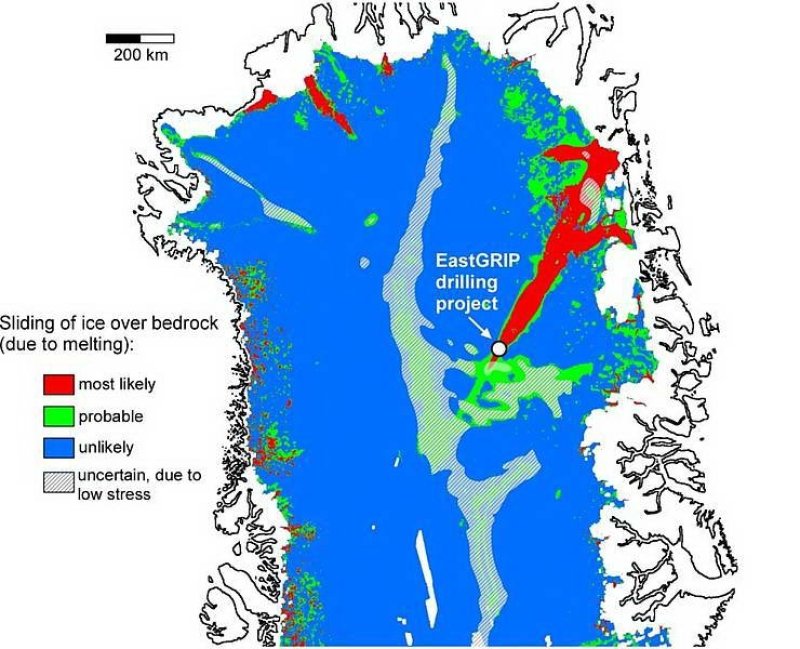
So far, it has been assumed that melt formation at the base of the ice sheet and the resulting gliding affects ca 50 percent of the area. Due to the new measurements, one has to assume that only a significantly smaller area is affected.
(c) Paul Bons, Ilka Weikusat
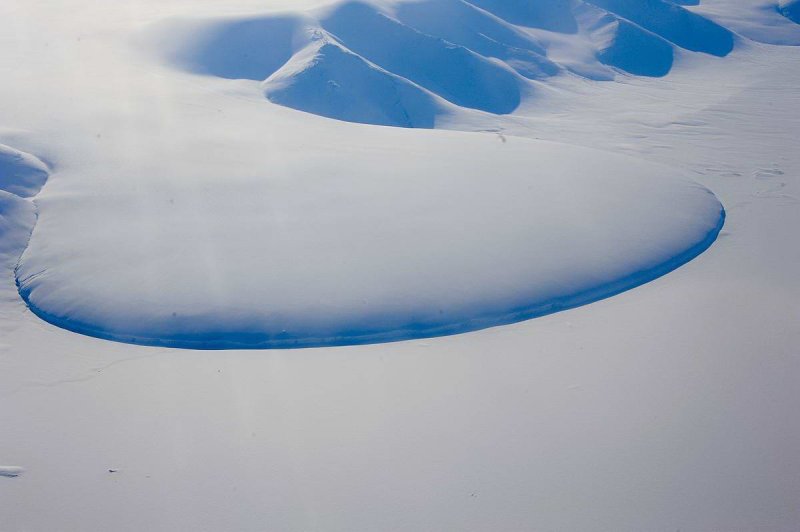
Piedmont glacier in north-eastern Greenland
(c) Coen Hofstede
Este artigo foi traduzido automaticamente e pode conter pequenas imprecisões; em caso de dúvida, consulte a versão original em Inglês.