First time live deep-sea frogfish filmed
scuba divingenvironmentmarine lifebioluminescencedeep-sea exploration
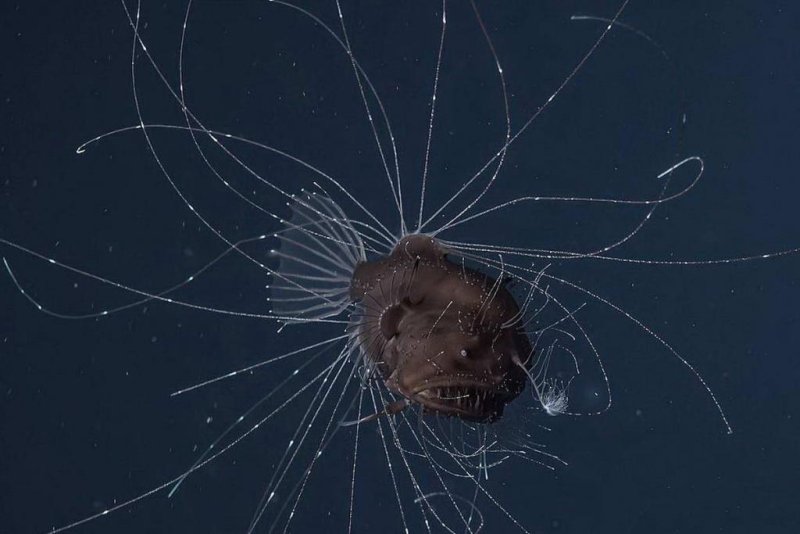
Fanfin monkfish, Photo: © Rebikoff Foundation
Video shows swimming behaviour of a self-luminous fanfin monkfish For the first time ever a deep-sea frogfish of the family Caulophrynidae could be observed live. Little is known about these fish, which are found only in the deep sea and are also called fanfin monkfish. The observation was achieved by Kirsten and Joachim Jakobsen with their manned submersible "LULA1000" of the Rebikoff-Niggeler Foundation. The images of the frogfish originated at a depth of 800 meters during a diving mission south of the Azorean island of São Jorge. During 25 minutes, spectacular video footage and photographs of a pair of Finsfin Monkfish were made, which now link to Science ( http://www.sciencemag.org/news/..deep-sea-anglerfish-stuns-biologists ) were published. It is an apparently pregnant female with a grown dwarf male. Deep-sea frogfish show an extreme sexual dimorphism. The females are often ten times the size of the males. If the male has found a female, it bites first on her stomach and then grows permanently with this. The female nourishes the male through his bloodstream. If the fertilization is done, or lack of food occurs, the male can apparently be digested by the body juices of the female once before. Theodore W. Pietsch of the University of Washington at Seattle, an expert on this fish group, has identified the frogfish as belonging to the species Caulophryne jordani. He writes: "The observed specimen of the species Caulophryne jordani is extremely rare, known only by 14 female specimens in natural history collections worldwide. Males of this species were previously completely unknown and have never been seen before, of the entire fish family, there are now only 4 become known male specimens, three of them in collections. There are currently 160 described species of deep sea angler fish, but this is the first live observation of a female deep sea angler fish in the natural habitat carrying a parasitic male dwarf. Also new is the documentation of luminescent fin rays of the fish and the peculiar resting position of the fish pair. Sharpness and resolution of the images reveal the finest structural details. The video shows a never before documented behaviour that suggests the function of the characteristic elongated fin rays and tentacles. The enormously long nerve-pierced fin rays of the dorsal and anal fin form a network of sensory antennae, similar to a cat's proboscis. The fish can thereby react to the slightest flow differences, for example by the movement of prey or predators. Particularly unusual are the small bioluminescent spots that appear from the tips of the pectoral fins and caudal fin rays and at intervals along the dorsal and anal fin rays. " Antje Boetius, deep-sea researcher and director of the Alfred Wegener Institute, says, "I have spent hundreds of hours observing the deep sea, but this is one of the most amazing video recordings ever. The video impressively demonstrates the otherness of deep-sea life, and how important it is to observe these animals in their natural environment to understand their behaviour and their adaptation to local conditions. The explorers Kirsten and Joachim Jakobsen, supported by the Rebikoff Foundation, devote their work to discovering and documenting life in the deep sea, where more than a million unknown species are likely to be discovered. The deep sea around the Azores, on which the work of the Rebikoff Foundation is concentrated, is a hotspot of marine life and one of the largest marine protected areas in the world. We definitely need more observations from the Azores and Mid-Atlantic Reach area, especially as these areas are now being considered for deep-sea mining." Interesting Facts regarding Frogfish: https://blog.mares.com/biology-the-frogfish-865.html Video Deep-Sea Frogfish: https://youtu.be/anDIlMVgNwk