Newly-described “parasol” sponges graceful but deadly
environmentoceanmarine biologypredatorsdeep-sea

The carnivorous sponge Cladorhiza kensmithi, about 3,200 meters below the ocean surface on the Gorda Ridge, offshore of Northern California.
(c) 2015 MBARI
Deep-sea sponges feed on small crustaceans When most people think of sponges, they think of those in the kitchen sink or perhaps graceful barrel sponges that grow around coral reefs. But in the dark depths of the ocean, there are some sponges that have evolved into deadly predators that catch and digest small prey.
In a new study published in the Zootaxa journal, marine biologists describe three newly discovered species of sponges that live in the deep waters off the coast of California and the Gulf of California.
Most sponges are passive filter feeders. They pump sea water through their bodies and feed on microscopic unicellular organisms and bacteria. In the last 20 years, marine biologists discovered that many deep-sea sponges are predators. They have adapted to low-nutrient habitats by catching larger, more nutritious prey.
The three species of sponges protrude from the seafloor like tiny parasols. They consist of thin, vertical stems with shield-like discs on top. Numerous long filaments radiate from the edges of the "parasol"in all directions.
These sponges are deadly traps for small organisms. Under the microscope, the researchers observed that on the filaments, there were dozens of tiny shrimp-like creatures trapped in fluid-filled bags called "cysts". When prey drifts near the filaments, it is ensnared by tiny hooks and then enveloped by the sponge’s body and slowly digested.
All three new sponges are members of the genus Cladorhiza. Two of the sponge species were caught on videotape by remote operated vehicles (ROVs) at depths of about 2,500 to 4,100 metres.
One of the three new species, Cladorhiza Kensmithi, is about 20 centimetres tall. They use root-like rhizoids to secure their stalks in the muddy seafloor. When they were first observed, the researchers nicknamed them "Sputnik Sponge", as their filaments and large, striking antenna discs resemble antennae on a satellite.
In contrast to the Cladorhiza Kensmithi’s muddy habitat, the Cladorhiza mexicana sponge lives in deep-sea lava flows at the southern end of the Gulf of California. This species can grow up to 30 centimetres tall.
The third new species, Cladorhiza hubbsi, was identified from a specimen recovered from the seabed off southern California.
More information: www.mbari.org Link to study: www.mapress.com/j/zt/article/view/zootaxa
Video: https://youtu.be/KZ_rwvx7hrQ

Researchers named this delicate sponge Cladorhiza mexicana because it was discovered in Mexican territorial waters near the entrance to the Gulf of California.
(c) 2015 MBARI
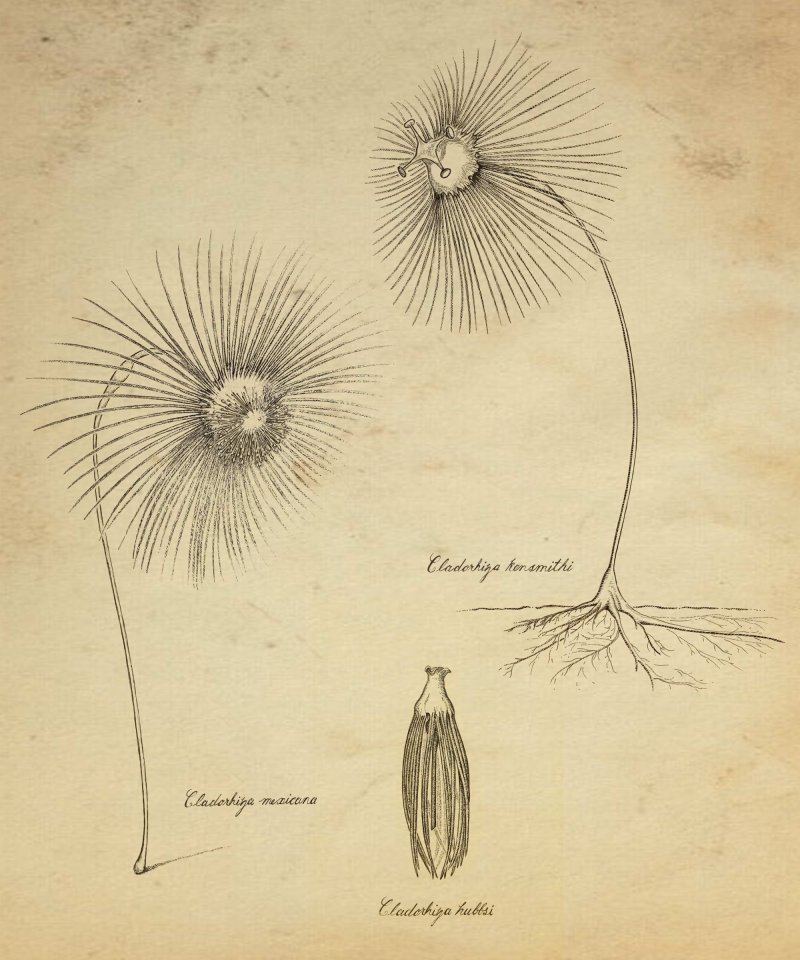
Kelly Lance (MBARI) created this image in the style of illustrations made during the Challenger Expedition in the late 1870s. The new species are Cladorhiza kensmithi (upper right), Cladorhiza hubbsi (fragment; bottom), and Cladorhiza mexicana.
(c) Kelly Lance, 2017 MBARI
Ta članek je bil samodejno preveden in lahko vsebuje manjše netočnosti; v primeru dvoma si oglejte izvirno angleško različico.