Arctic deep sea: colonization in Slow Motion
environmentmarine researcharctic deep seacolonizationsedentary animalsdeep-sea ecosystems
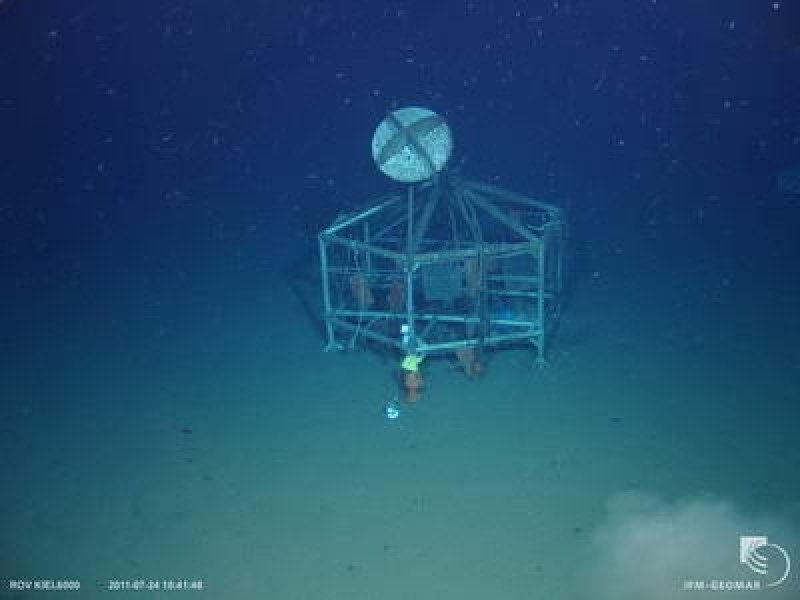
Scientists of the Alfred Wegener Institute have investigated which species settle in the Arctic deep sea. For this purpose, they erected settlement plates on a steel scaffold, which were photographed and sampled over a period of 18 years with the aid of ROV. (c) ROV Kiel 6000 GEOMAR
Sedentary animals can only conquer new habitats extremely slowly At the bottom of the Arctic deep sea lives a variety of animals attached to rocks and with filter apparatus or tentacles to feed by removing nutrients from the water. However, decades can pass before such a colony becomes established. This is the conclusion of scientists from the Alfred Wegener Institute, Helmholtz Center for Polar and Marine Research (AWI) from an 18-year long-term experiment, which they are now reporting on in the journal "Limnology and Oceanography". Some sponge types stand on stones, tentacles of feather stars (comatulida) and sea lilies weigh their tentacles in the current. When remote-controlled underwater vehicles are travelling on the seabed of the Arctic deep sea, their cameras catch images of these sedentary animals again and again. Their most important habitats include the so-called dropstones. These are rocks and boulders, frozen on land into a glacier and transported into the sea. As soon as the ice melts, the stones sink to the bottom of the sea, providing the solid ground upon which many of these species rely. But how long will it take for the first settlers in the Arctic deepwater to use this offer? And how does the partnership develop further? "So far, we have hardly known anything about it", explains Michael Klages from the AWI. Now there are new findings from the deep-sea observatory HAUSGARTEN, which is located in the Fram Strait between Spitsbergen and Greenland and in which the AWI carries out various ecological long-term studies. In July 1999, Michael Klages, together with colleagues from the AWI, placed a heavy metal frame on the seabed at a depth of 2,500 meters. Attached to it were so-called settlement plates made of clinker bricks, Plexiglas and wood, which could offer the sedentary subsistence dwellers. In 2003 and 2011, the team of this design paid visits with remote-controlled underwater vehicles; the end of August 2017, the frame was finally brought back to the surface. The first author of the current scientific publication, Kirstin Meyer-Kaiser, then "scrutinized" the salvaged colonization plates, counted the individual organisms, collected them and classified them taxonomically. "In this experiment, we have seen that the colonization of such habitats in the Arctic deep sea is extremely slow," says Michael Klages. After four years, only single-celled organisms from the group of foraminifera had appeared on the plates; after twelve years, only one single multicellular animal had been added to the polyp Halisiphonia arctica. And even after 18 years, the number of invertebrates limited to just 13 species. From this modest yield, however, the researchers do not conclude that the natural hard substrates are not important habitats - quite the contrary: "Without them, there would not be quite a few sedentary animals in the Arctic deep sea," emphasizes Michael Klages. The now omnipresent civilization waste in the oceans does not seem to be a good substitute. Although the AWI team has already seen a plastic bottle on the images, taken by remote-controlled underwater vehicles, on which a sea lily grew. "That's how we came up with the idea of using Plexiglas plates in our experiment," explains the researcher. "We wanted to see if they could be populated just as well as natural subsoil." That does not seem to be the case. Anyway, after 18 years significantly fewer animals had settled on the plastic than on the clinker bricks. However, the latter could not keep up with a neighbouring rock reef, where at least 65 different invertebrates could be detected. It may even have not been enough for almost two decades to reach the theoretically possible biodiversity on the plates. The aforementioned reef, however, is much older and had correspondingly more time to attract a wider range of residents. The results also provide important insights into the sensitivity of deep-sea ecosystems. "If disturbances eliminate the sedentary inhabitants at the seabed, it would take decades, until the cohabitation has recovered," says Michael Klages. In the Arctic, such disturbances can occur through fishing or drilling for oil and gas. Significantly far-reaching consequences, however, are to be expected, for example, in the depths of the Pacific, where large-scale manganese nodules will be mined in the future.
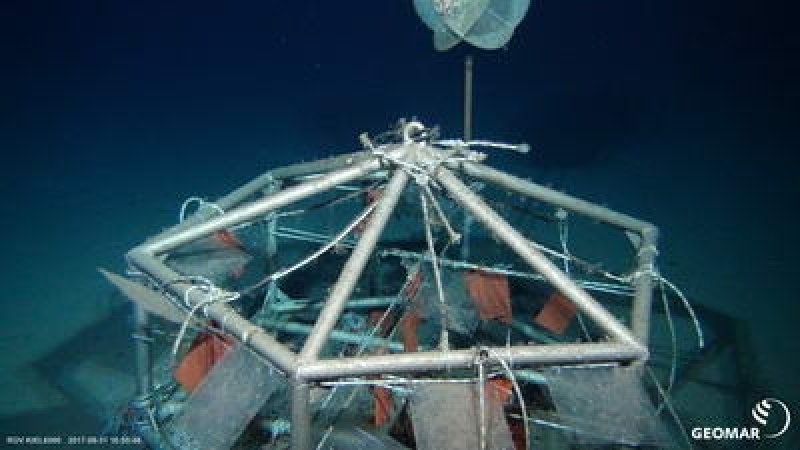
Scientists of the Alfred Wegener Institute have investigated which species settle in the Arctic deep sea. For this purpose, they erected settlement plates on a steel scaffold, which were photographed and sampled over a period of 18 years with the aid of ROV. (c) ROV Kiel 6000 GEOMAR
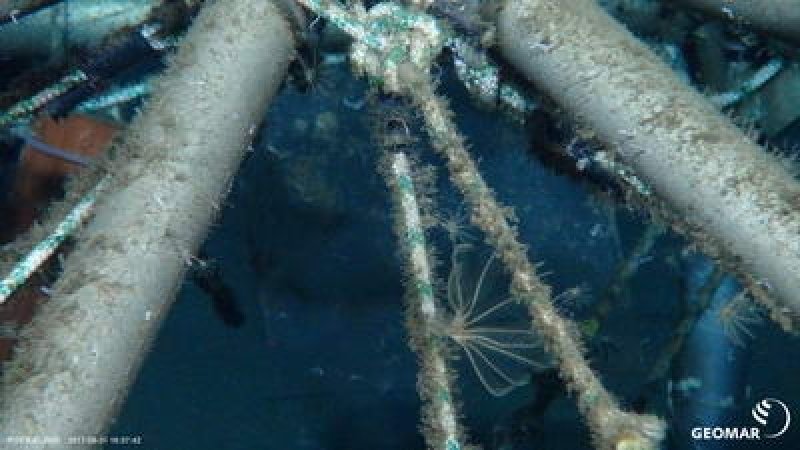
Scientists of the Alfred Wegener Institute have investigated which species settle in the Arctic deep sea. For this purpose, they erected settlement plates on a steel scaffold, which were photographed and sampled over a period of 18 years with the aid of ROV. (c
Данная статья была переведена автоматически и может содержать незначительные неточности; в случае сомнений, пожалуйста, обратитесь к оригинальной английской версии.