Solving the mystery of floating rocks
environmentbuoyancypumice stonesvolcanic rocksunderwater volcanoes
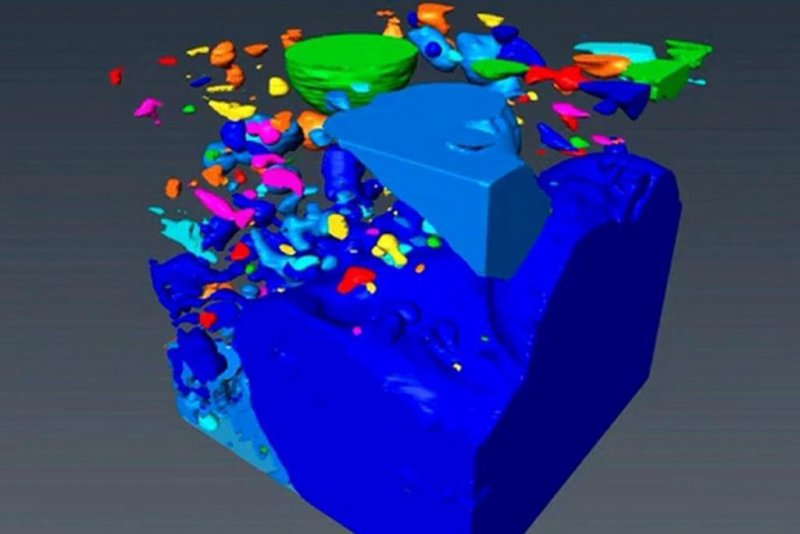
A cube-shaped sample of pumice (blue-gray) and pockets of trapped gases (other colors) - see also Video (link at end of text)
(c) Berkeley Lab, UC Berkeley
Scientists have discovered how rocks can float Some rocks can float on water for years at a time, forming miles-long debris patches that drift for thousands of miles on the ocean surface. Now, scientists have discovered how they do it, and why they eventually sink.
Scientists at the Department of Energy's Lawrence Berkeley National Laboratory (Berkeley Lab) have solved this mystery by scanning samples of lightweight, glassy and porous volcanic rocks known as pumice stones. These X-ray experiments were conducted at Berkeley Lab's Advanced Light Source (ALS), an X-ray source known as a synchrotron.
The long-lived buoyancy of these rocks can help scientists discover underwater volcano eruptions and understand how the floating pumice serves as a seafaring nutrient-rich medium that spreads species around the world. In addition, it is a hazard for boats, as the ashy mixture of ground-up pumice can clog ship engines.
While scientists have known that pockets of gas in the pumice pores enable the pumice to float, they don’t know how the gases remain trapped for prolonged periods. The mystery deepens when one considers that the pumice’s pores are largely open and connected, like an uncorked bottle.
Interestingly, some pumice stones in the laboratory have been observed to sink during the evening and surface during the day.
For their investigation, the researchers coated bits of water-exposed pumice taken from Medicine Lake Volcano near Mount Shasta in Northern California and Guatemala’s Santa María Volcano.
Then, they used an X-ray imaging technique known as microtomography to study the concentrations of water and gas – measuring it in microns (thousandths of a millimeter) - within preheated and room-temperature pumice samples.
The resultant three-dimensional images were so data-intensive that it was a challenge to quickly identify the concentrations of gas and water in the samples’ pores. This problem was solved by a visiting undergraduate researcher from Peking University, Zihan Wei, used a data-analysis software tool that incorporates machine learning to automatically identify the components of gas and water in the images.
The researchers discovered that the gas-trapping processes found in the pumice stones is related to surface tension, a chemical interaction between the water surface and the air above it that acts like a thin skin.
"The process that's controlling this floating happens on the scale of human hair. Many of the pores are really, really small, like thin straws all wound up together. So surface tension really dominates," said Kristen E Fauria, a UC Berkeley graduate student who led the study, published in Earth and Planetary Science Letters.
The team also found that a mathematical formulation known as percolation theory, which explains how a liquid enters a porous material, accounts for the gas-trapping process in pumice. In addition, gas diffusion - which describes how gas molecules seek areas of lower concentration - explains the eventual loss of these gases and the reason the stones sink.
Michael Manga, a staff scientist in Berkeley Lab's Energy Geosciences Division and a professor in the Department of Earth and Planetary Science at UC Berkeley, said, "There are two different processes: one that lets pumice float and one that makes it sink." The X-ray studies helped to quantify these processes for the first time. The study showed that in some cases, previous estimates for flotation time were off by several orders of magnitude.
The water surrounds and traps gases in the pumice, forming bubbles that make the stones buoyant. Surface tension keeps the bubbles locked inside for prolonged periods. The bobbing observed in laboratory experiments is due to the expansion of trapped gas during the heat of the day, and the contraction when the temperature drops at night.
The X-ray work at the ALS, together with studies of small pieces of pumice floating in water in Manga's UC Berkeley lab, helped researchers develop a formula that predicts how long a pumice stone will typically float based on its size.
The study triggered more questions, such as how pumice, ejected from deep underwater volcanoes, finds its way to the surface. The researchers have also conducted X-ray experiments at the ALS to study samples from so-called "giant" pumice that measured more than a meter long.
That stone was retrieved from the seabed in the area of an active underwater volcano hundreds of miles north of New Zealand, during a 2015 expedition that Fauria and Manga participated in.
Underwater volcano eruptions are not as easy to track down as eruptions on land. Pumice stones from underwater volcano eruptions vary widely in size but can typically be about the size of an apple, while pumice stones from volcanoes on land tend to be smaller than a golf ball.
"We're trying to understand how this giant pumice rock was made," Manga said. "We don't understand well how submarine eruptions work. This volcano erupted completely different than we hypothesized. Our hope is that we can use this one example to understand the process."
Fauria agreed that there is much to learn from underwater volcano studies, adding that X-ray studies at the ALS will play an ongoing role in her team's work.
Video
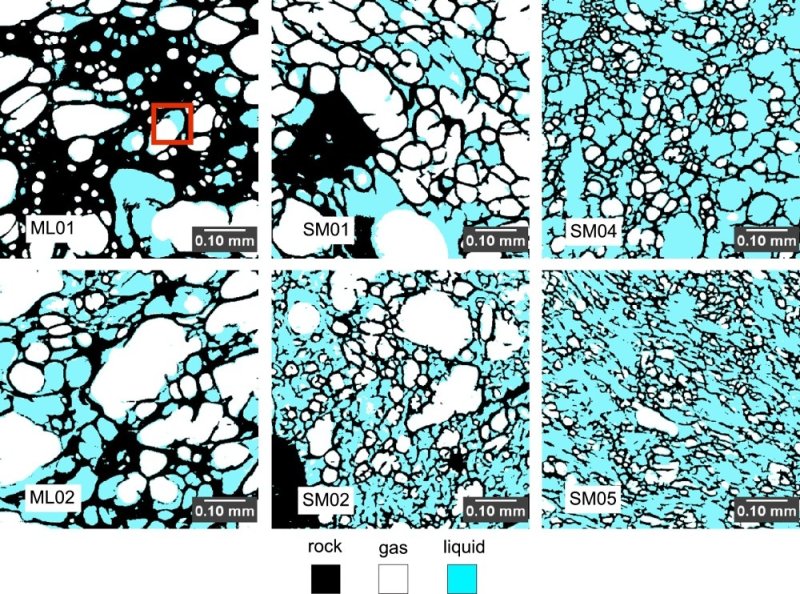
Concentrations of liquid and gas in samples of pumice stones are labeled in these images, produced by X-ray microtomography at Berkeley Lab’s Advanced Light Source.
(c) UC Berkeley, Berkeley Lab
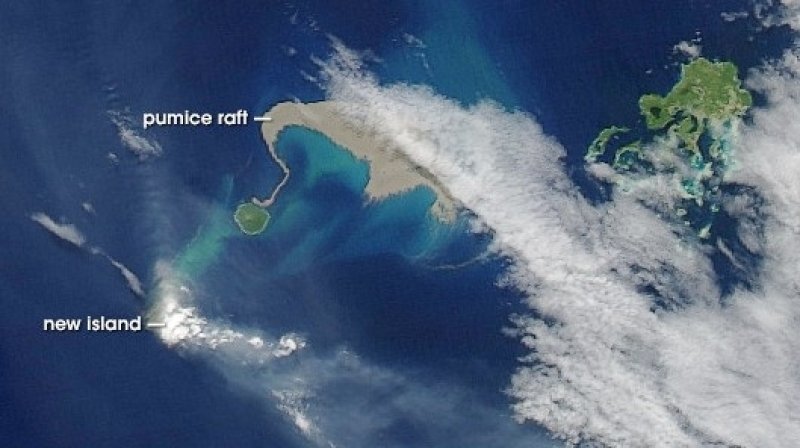
In this 2006 satellite image, a large "raft" of floating pumice stones (beige) appears following a volcanic eruption in the Tonga Islands.
(c) Jesse Alan/NASA Earth Observatory, Goddard Space Flight Center
이 기사는 자동 번역되었으며 약간의 오류가 포함될 수 있습니다. 의심스러운 점이 있으면 원문 영어 버전을 참조하십시오.