Corals in the Red Sea provide natural record of monsoon activity
environmentmarine lifecoral reefoceanclimate change
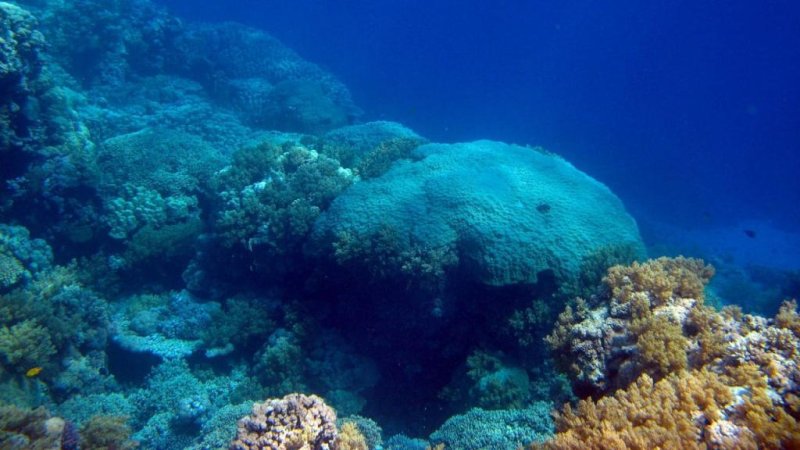
A massive, 300-year-old Piorites coral in the Red Sea, similar to that used to gather information on wind patterns related to the South Asian monsoon. Photo: © Konrad Hughen, Woods Hole Oceanographic Institution
Barium in the coral skeleton records the intensity of the South Asian summer monsoon When it comes to understanding the future climate, the South Asian summer monsoon offers a paradox: most climate models predict that monsoon rains and wind will intensify with increasing human warming - but the weather data gathered in the region shows that rainfall has been decreasing in the past 50 years. A recent study by the Woods Hole Oceanographic Institution (WHOI), recently published online in the journal Geophysical Research Letters, could help explain this discrepancy. With the help of chemical data from corals in the Red Sea, scientists reconstruct wind data from almost three centuries, providing a natural record of monsoon intensity. The analysis of the data shows that the monsoon wind has indeed increased in recent centuries. "The South Asian monsoon is incredibly important," explains Konrad Hughen, paleoclimatologist at WHOI and co-author of the study. "It's one of the largest climate systems in the world, providing nearly a billion people with water - but we do not quite understand its long-term behaviour - it's a very complicated system." The problem, he adds, is that based on historical records of rainfall, averaging over a large region is difficult. Hughen and his colleagues were able to uncover this information thanks to the behaviour of the monsoon winds themselves. One branch of the monsoon moves mostly from west to east and traverses the Sahara in north-eastern Africa, absorbing fine dust and clay. The winds are then channelled through the Tokar Gorge, a narrow mountain pass in eastern Sudan, and the dust carried by the wind reaches the Red Sea. The dust absorbed in the Sahara contains a form of barium that dissolves easily in seawater. Every year, corals integrate some of this barium into their skeletons why they grow. So they store information about wind and dust during the summer monsoon over hundreds of years. "The barium gives us an indication of the wind," says Hughen. "The more barium we found in a layer of coral, the more wind came through the Tokar Gorge in the year it was formed, and based on these winds, we can calculate the position of the low pressure systems that caused it, and we found out that they lay mainly over the Indian subcontinent, which confirmed the connection of the winds to the monsoon." The data in the corals seem to prove that historical records of precipitation miss a broader picture, Hughen said. Stronger winds would have increased the humidity on the Indian subcontinent, although records show that rainfall is decreasing. "It could be that these records simply missed part of the rainfall, especially in the past when they were less reliable," he says. "Rain varies greatly from location to location, and if you record rainfall at just a few fixed points, local variations may not be recorded with a complete wrong final result." The coral's climate archives show that the strength of the monsoon actually increases over time - a trend consistent with existing climate models - but its variability decreases from decade to decade. This indicates that the circulation of the monsoon has become more stable with increasing warming of the climate, so that extra strong winds and rains in the coming years could be normality and not the exception.
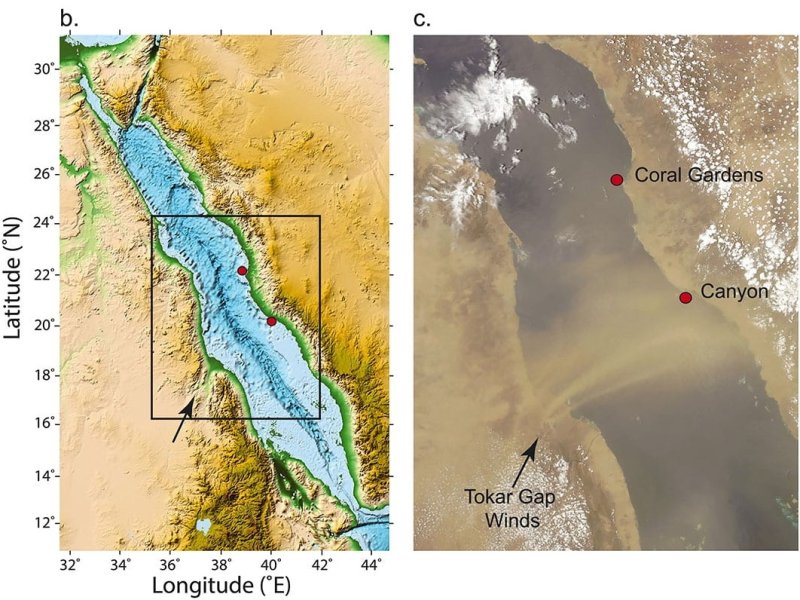
Geographical setting of the studied area in the Red Sea (a and b) and NASA MODIS satellite image of July 26, 2012, showing dust from winds associated with the South Asian monsoon in relation to the two study areas the Sahara was blown through the Tokar gap, artwork: © Bryan, et al.
این مقاله به صورت خودکار ترجمه شده است و ممکن است حاوی اشتباهات جزئی باشد؛ در صورت هرگونه شک و تردید، لطفاً به نسخه اصلی انگلیسی مراجعه کنید.